
Job Hunt
A fast-paced third-person puzzle game exploring spatial traversal, key pickups, and escape timing.
CONCEPT
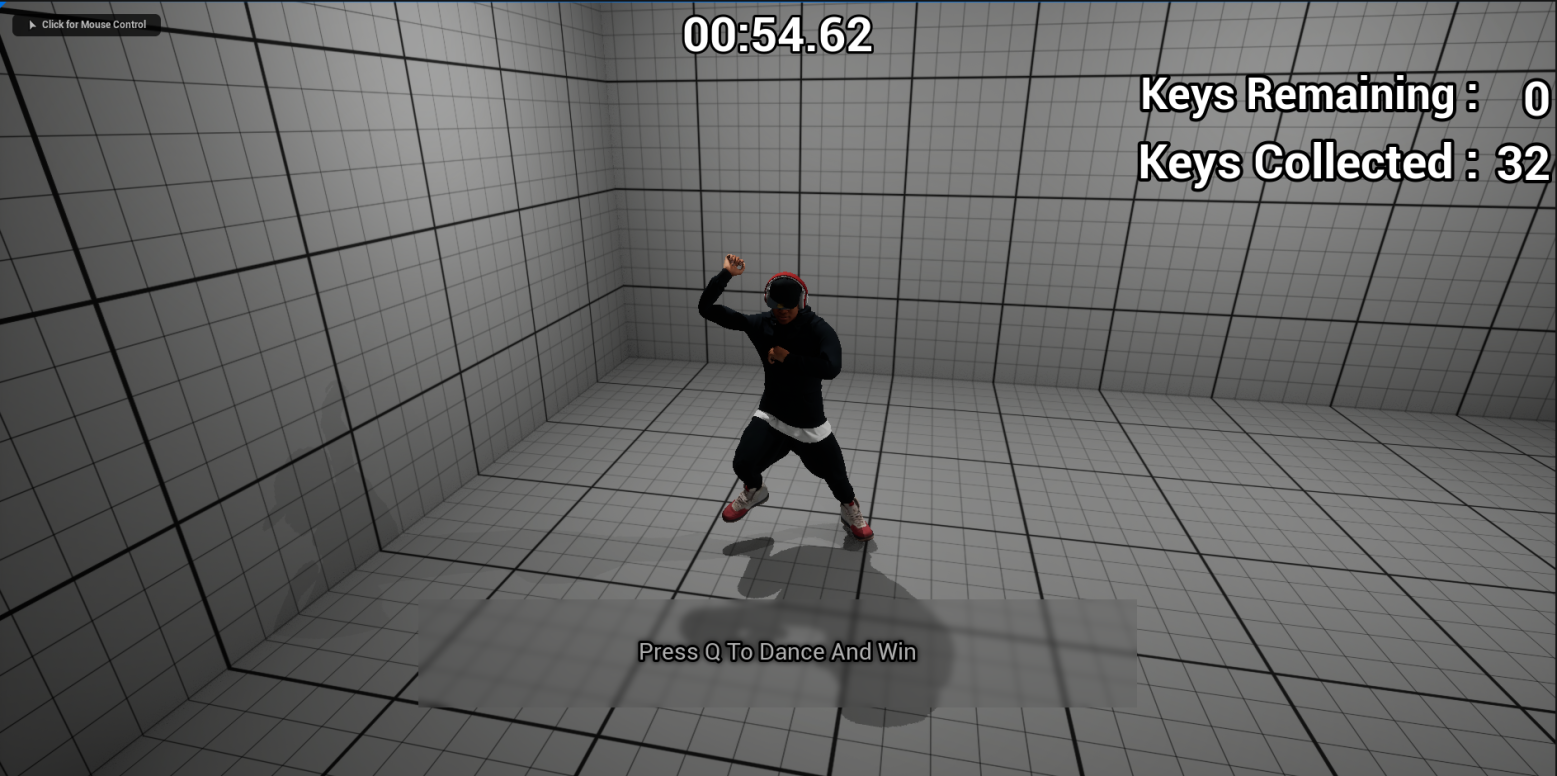
Job Hunt is an energetic, high-speed third-person puzzle game where you are trapped in a testing maze. You must collect scattered access keys, unlock exit doors, race against a ruthless countdown timer, and trigger the "Dance to Win" state to escape and secure your opportunity.
MY ROLE
Solo Creator • Gameplay Designer • Unreal Engine Developer. Responsible for all mechanics, Blueprints logic, timer routines, input mapping, tutorial blockout, UI widgets, and sound design.
DEVELOPMENT
Built across multiple sprint iterations in Unreal Engine:
- Pickup & Detection System: Precise actor overlap volumes detecting key collisions and updating global HUD counters.
- Millisecond Timer: Real-time countdown timer running on game state ticks with formatted millisecond precision (
00:54.62). - Dance To Win State: Custom animation montage trigger (
Press Q To Dance And Win) that activates once remaining keys reach zero. - Level Flow: Main Menu, Settings, Credits, Level Select, and testing arena with 32 collectable keys.
- Audio Rig: Positional footstep sounds and main menu atmospheric music.
CHALLENGES
In early devlog builds (v0.3.5), performance consumption and frame pacing lagged due to unoptimized actor ticking across all 32 spawned key actors, and settings persistence in the UI menu required rewriting widget bindings.
HOW I SOLVED IT
Disabled tick events on passive key actors, switching key pickup handling entirely to event-driven overlap triggers. Streamlined physics collision channels by using simple box primitives instead of complex mesh collision geometry.
RESULT
Playable prototype v0.3.5 validating tight movement controls, working pickup systems, and rewarding win/loss feedback loops.
LESSONS
Taught the value of event-driven Blueprints architecture over per-frame tick polling, the importance of instant responsiveness in arcade-style controls, and how sound effects transform simple box collisions into satisfying game feedback.